
The Countdown to Canton
Five years goes by fast in the NFL. It feels like yesterday that Adrian Peterson was still strapping on a helmet, searching for one last carry to push his historic statistics just a little higher. He finally stepped away after the 2021 season, finishing his legendary run with short stints in Tennessee and Seattle. That quiet exit started a clock. In early 2027, Peterson will officially become eligible for the Pro Football Hall of Fame.
Thank you for reading this post, don't forget to subscribe!When the selection committee meets to debate the Class of 2027, Peterson’s name will command the room. He belongs to a dying breed of workhorse running backs. Today’s NFL is defined by committee backfields, short-passing targets, and load management. Peterson was the opposite. He was a violent, straight-line runner who demanded the ball 25 times a game and wore defenses down by sheer force of will. He did not just run. He punished.
Yet, the first-ballot designation is a rare honor reserved for the absolute best of the best. Does Peterson fit the mold? To answer that, we have to look at the numbers, the peak moments, the controversies, and how the game itself has changed since he first entered the league.
The Peak: A Historic 2012 and the Last Non-QB MVP
Any conversation about Peterson’s greatness must start with the 2012 season. It remains one of the most astonishing individual campaigns in sports history. On Christmas Eve in 2011, Peterson tore both his ACL and MCL in a game against the Washington Commanders. At the time, such an injury was considered a career-altering blow that required a year or more of recovery. Many wondered if he would ever regain his signature explosiveness.
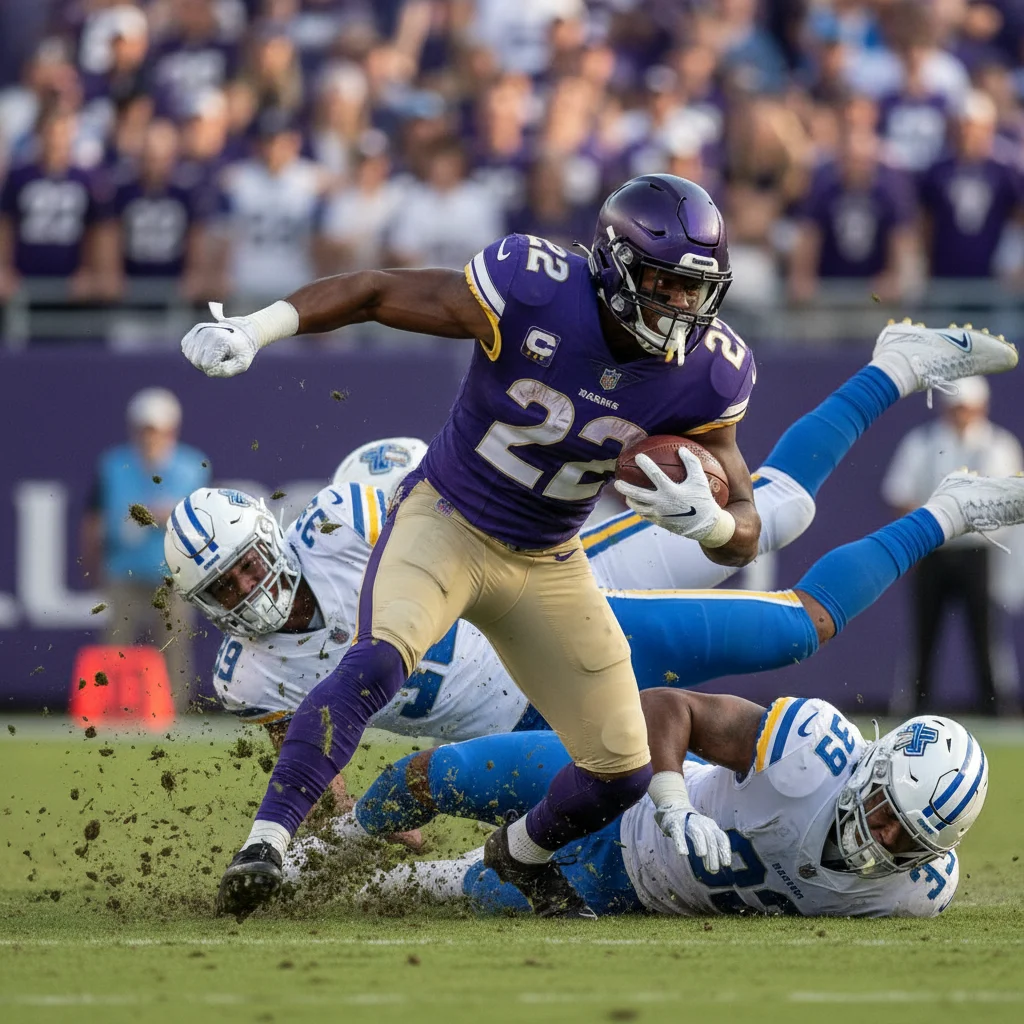
He was back on the field for Week 1 of the 2012 season, just nine months later. What followed was nothing short of miraculous.
Peterson ran for 2,097 yards that year, falling just nine yards short of Eric Dickerson’s single-season rushing record. He did this while playing in a Minnesota Vikings offense that lacked a consistent passing threat, meaning opposing defenses regularly stacked eight or nine players in the box to stop him. It did not matter. Peterson averaged an astounding 6.0 yards per carry, scoring 12 touchdowns and carrying a mediocre Vikings team to a playoff berth.
His performance earned him the NFL Most Valuable Player award. He is the last non-quarterback to win the honor. In an era completely dominated by passers like Tom Brady, Peyton Manning, and Aaron Rodgers, Peterson’s MVP season stands as a monument to what a truly dominant running back can achieve.
By the Numbers: How Peterson Ranks All-Time
Voters love career milestones, and Peterson’s resume holds up under any statistical lens. Over his 15-year career, he compiled numbers that place him among the absolute elite in football history:
- Rushing Yards: 14,918 yards. This ranks fifth in NFL history, trailing only Emmitt Smith, Walter Payton, Frank Gore, and Barry Sanders.
- Rushing Touchdowns: 120. This ranks fourth all-time, behind Emmitt Smith, LaDainian Tomlinson, and Marcus Allen.
- Yards Per Game: During his ten seasons with the Vikings, Peterson averaged 95.5 rushing yards per game, a number that reflects his sustained dominance.
- Accolades: He was a seven-time Pro Bowler, a four-time First-Team All-Pro, and a member of the NFL 2010s All-Decade Team. He also won the league rushing title three times (2008, 2012, and 2015).
These are not just Hall of Fame numbers; they are first-ballot numbers. Every single eligible player ahead of him on the all-time rushing yards list went into Canton on their first year of eligibility, with the exception of Frank Gore, who is not yet eligible. Peterson’s peak performance was arguably higher than almost anyone on that list.
The Journeyman Years and the Evolution of the Position
After the Vikings parted ways with Peterson following the 2016 season, his career entered a new phase. He became a traveling mercenary, playing for six different franchises over his final five seasons. There were stops with the New Orleans Saints, Arizona Cardinals, Washington Commanders, Detroit Lions, Tennessee Titans, and Seattle Seahawks.
Some analysts argue these late-career struggles dilute a player’s legacy. Peterson was no longer the centerpiece of an offense; he was a depth piece brought in to cover for injuries. In New Orleans, he struggled to find a role alongside Alvin Kamara. In Seattle and Tennessee, he looked like a shadow of his former self, averaging under three yards per carry in limited action.
But history tends to forget the twilight years. Emmitt Smith’s time with the Arizona Cardinals did not hurt his standing, nor did Jerry Rice’s stint with the Seattle Seahawks. If anything, Peterson’s ability to run for 1,042 yards at age 33 with Washington in 2018 and another 898 yards at age 34 in 2019 proved his incredible physical longevity. In a league where running backs are often considered old at 26, Peterson was still producing as a starter well into his 30s.
The Off-Field Shadow and the Selection Process
While Peterson’s on-field resume is nearly flawless, his legacy is complicated by off-field events. In 2014, Peterson was indicted by a grand jury in Texas on charges of reckless or negligent injury to a child. The case involved the discipline of his four-year-old son with a wooden switch. Peterson ultimately pleaded no contest to a misdemeanor charge of reckless assault, received probation, and was suspended by the NFL for the majority of the 2014 season.
The Hall of Fame’s selection committee is explicitly instructed to judge candidates based solely on their on-field contributions. Section 4(e) of the Pro Football Hall of Fame bylaws states that nominations must be based on “professional football merits” only. Off-field behavior, legal issues, and personal controversies are officially off the table during the debate.
However, the committee is made up of human beings. Voters have occasionally let off-field issues affect their timelines for certain candidates, even if they do not admit it publicly. Players like Terrell Owens faced delays in their induction, though in Owens’ case, his issues were mostly related to locker room dynamics and media relationships. How the voters handle Peterson’s past will be one of the most closely watched aspects of the Class of 2027 selection meeting.
The Verdict on First-Ballot Status
When the Class of 2027 finalists are announced, Adrian Peterson should be the easiest choice on the ballot. The running back position has been drastically devalued in the modern game, making it highly unlikely we will ever see another player reach the statistical heights that Peterson achieved. He represents the end of an era.
He was the last true bell-cow back to carry an entire franchise on his shoulders. He won an MVP in a quarterback-centric league. He overcame a career-threatening knee injury to post one of the greatest individual seasons ever recorded. He sits comfortably in the top five of almost every major rushing category.
There will be debates in the selection room, and some voters may hesitate due to his off-field history. But when it comes to the pure impact he had on the game of football, Adrian Peterson is a first-ballot Hall of Famer. Anything less would be a disservice to one of the most dominant athletes to ever play the game.
