


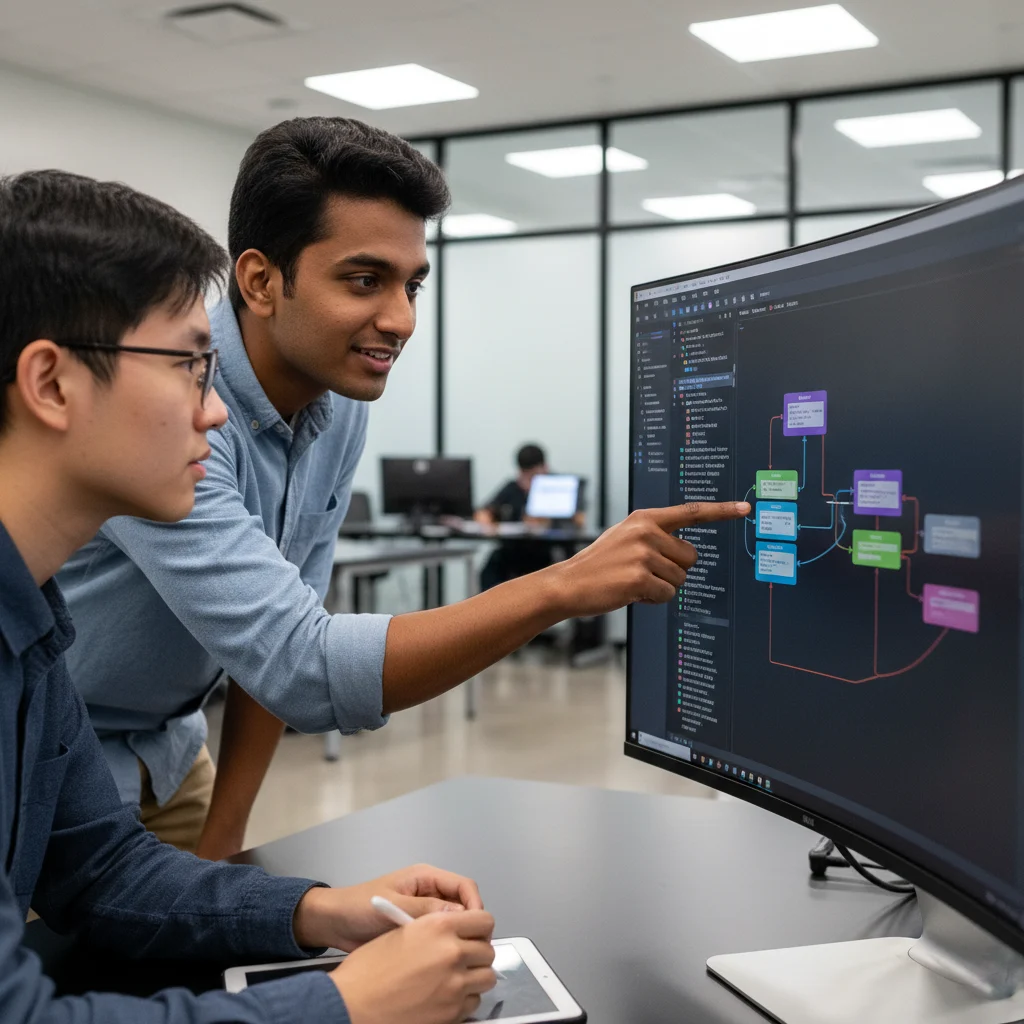
In a packed computer lab in Dhaka’s Dhanmondi district, twenty-one-year-old Farhan Kabir stares at his monitor. He is not typing code. Instead, he is speaking into a microphone, directing an AI autonomous agent to debug a complex database structure. A year ago, Farhan would have spent three hours writing this backend code by hand. Today, the machine does it in thirty seconds. His job is to audit, refine, and secure the output.
This scene represents a quiet revolution taking place across Bangladesh. By mid-2026, the country’s premier freelancing institutes have initiated a massive, coordinated overhaul of their training programs. Traditional courses in basic HTML, CSS, manual graphic design, and simple data entry are being phased out. In their place, a new curriculum has emerged, focused entirely on AI-driven design, prompt engineering, LLM orchestration, and hybrid development workflows.
The shift is not a luxury. It is a matter of survival for a country that houses over 650,000 active freelancers.
The Sudden Collapse of the Low-Skill Market
For over a decade, Bangladesh built its reputation as a hub for affordable digital labor. Students completed three-month courses in basic web design or search engine optimization, then immediately found work on global platforms like Fiverr and Upwork. But the arrival of highly capable generative AI systems shattered that model.
According to data from the Bangladesh Association of Software and Information Services (BASIS), global job postings for entry-level manual coding and basic graphic layout design fell by 45 percent between late 2024 and early 2026. Clients no longer want to hire someone to spend ten hours building a simple WordPress site when an AI builder can produce a template in minutes.
“The market we knew is gone,” says Tanvir Hossain, a senior academic director at one of Dhaka’s oldest IT training centers. “We noticed our graduates were struggling to secure even five-dollar contracts. The automated tools did their jobs better, faster, and for free. We realized that if we did not change what we teach, our training centers would become museums.”
This pressure led to a massive curriculum redesign. Top-rated institutes, including Creative IT Institute, CodersTrust, and Shikhbe Shobai, spent the first half of 2026 rewriting their entire catalog of programs.
What the New Curriculums Look Like
The revised courses look nothing like the tech education of five years ago. Instead of learning syntax rules by heart, programming students now focus on system architecture and code verification. They are taught how to write high-fidelity prompts, stitch together multiple APIs, and manage custom AI agents that do the heavy lifting of writing code.
The changes are equally dramatic in the design departments. Graphic design courses no longer start with the basic pen tool in Adobe Illustrator. Instead, students dive straight into advanced generative engines, learning how to control style consistency, train custom image models on brand-specific datasets, and use AI to generate complex user interfaces in Figma.
Some of the key modules introduced in these updated programs include:

- AI-Assisted Web Assembly: Teaching students to use autonomous coding tools to build, test, and deploy full-stack applications.
- AI Design Orchestration: Merging vector design with generative image tools to create highly customized marketing assets at scale.
- Prompt Engineering for Enterprise: Instructing students on how to construct complex system prompts and chain logical steps for business automation.
- Data Auditing and Security: Training freelancers to identify biases, security vulnerabilities, and copyright issues in AI-generated outputs.
“We are training pilots, not builders,” explains Tasnim Rahman, a lead instructor at Shikhbe Shobai. “We teach our students how to control the machine. If you only know how to build a website from scratch manually, you are competing against an engine that works at lightspeed. But if you know how to direct that engine, you become indispensable to global clients.”
Retraining the Trainers: A Monumental Challenge
Rewriting the curriculum was only the first hurdle. The more difficult task was retraining the teachers. Many instructors had built their careers on traditional web development methodologies and were hesitant to embrace tools that threatened to make their original skills obsolete.
To solve this, a coalition of top institutes, supported by a specialized fund from the government’s ICT Division, launched an intensive retraining initiative in early 2026. Over 1,200 instructors went through mandatory bootcamps led by international AI engineers.
The process was grueling. Instructors had to unlearn old habits and adapt to an environment where the technology updates every few weeks. Those who refused to adapt were reassigned or let go. The ones who remained became the vanguard of the new system.
“It was terrifying at first,” admits Farhana Yasmin, who taught HTML and PHP for eight years. “I felt like my entire career was being erased. But once I realized how much more I could accomplish by using AI platforms to write the boilerplate code, my perspective changed. I am a much better educator now because I teach my students to think structurally, not just syntactically.”

Real-World Success and the New Economic Reality
The early results of this educational pivot are starting to show. Freelancers who went through the pilot AI-driven courses in late 2025 are finding high-paying work that did not exist two years ago.
Consider the case of Sumon Ahmed, a 24-year-old developer from Chittagong. In 2024, his monthly earnings from building simple Shopify stores had dropped to under $300. He could barely cover his rent. After completing a specialized four-month course in AI-driven application development, his career turned around.
“I now build custom AI chatbots and automated workflow systems for real estate agencies in the United States,” Sumon says. “I don’t write every line of code myself. I use AI tools to generate the code, and then I integrate the systems. My monthly income has jumped to $2,800. The clients aren’t paying for my typing speed anymore. They are paying for my ability to solve their problems using the best technology available.”
The broader freelance economy is also feeling the impact. While the total number of low-value contracts has plummeted, the average value of contracts won by Bangladeshi freelancers has increased by 35 percent over the past nine months. This suggests that the strategy of upskilling the workforce is working.
The Path Forward for Bangladesh’s Tech Sector
The transformation is far from complete. Hundreds of smaller, unregistered training centers across the country still offer outdated courses to unsuspecting students, promising jobs that no longer exist. Industry leaders argue that tighter regulation and public awareness campaigns are needed to protect young people from wasting their time and money.
However, the shift among the top-tier, best-rated institutes has set a benchmark. The Bangladesh government’s ICT Division has taken notice, with plans to integrate similar AI-centric modules into public polytechnic institutes and universities by the end of 2026.
The era of the cheap, manual digital laborer is over. By embracing AI as a partner rather than a threat, Bangladesh’s freelancing community is carving out a new space in the global digital economy. The students in Dhanmondi are no longer just trying to keep up with the world; they are learning to lead it.

Omer Faruk
Omar Faruk is a digital content creator and online publisher passionate about sharing useful information, trending news, and practical guides for internet users. He focuses on creating engaging and easy-to-understand content related to global news, entertainment, technology, online earning, and lifestyle topics.
With a strong interest in digital media and SEO-friendly content writing, Omar Faruk continuously works to build informative platforms that help readers stay updated and make better online decisions.
He believes in delivering valuable, accurate, and user-friendly content that serves a global audience and improves everyday digital experiences.