
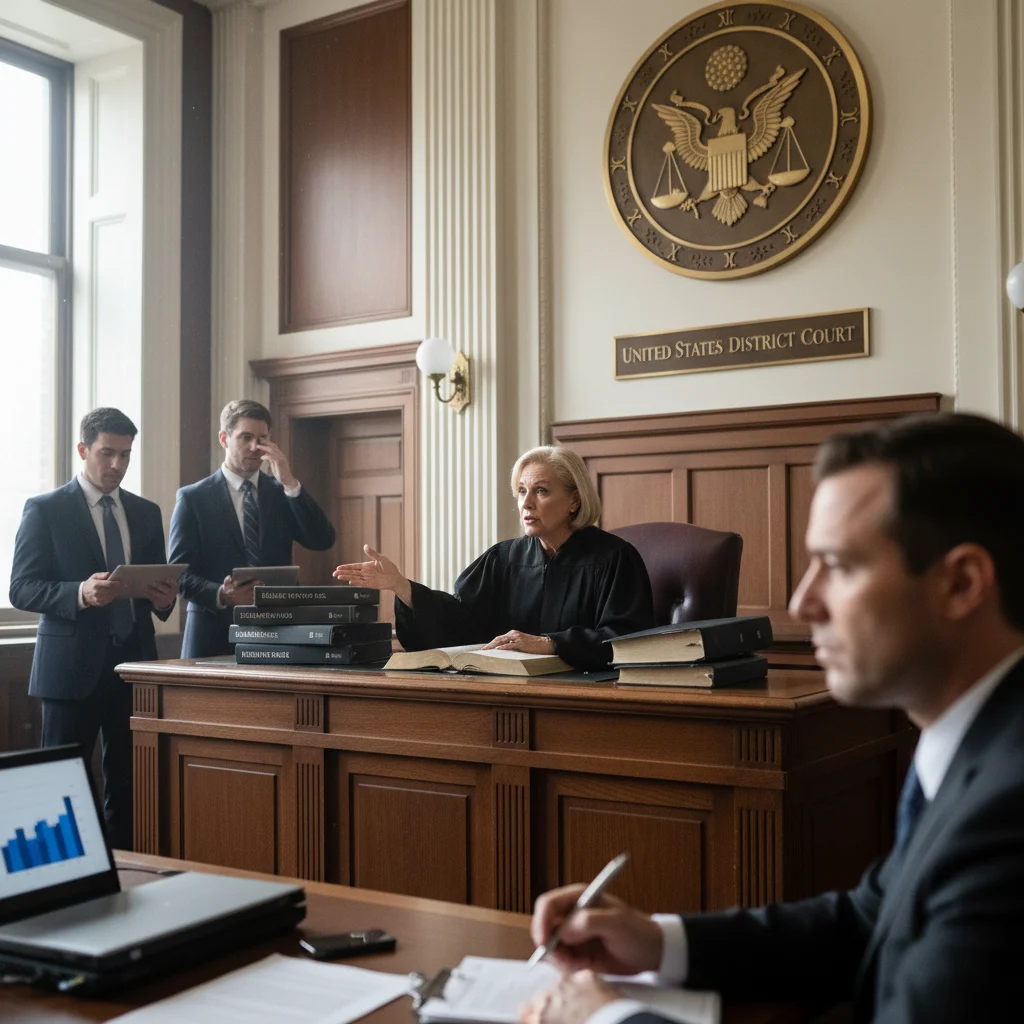
A federal judge has rejected the Department of Justice’s attempt to shield classified briefing materials concerning the devastating 2025 cyberattack on Baltic undersea pipelines. In a sharp ruling, the court declared that the government cannot use executive privilege as a blanket cover to hide factual information from the public.
U.S. District Judge Rudolph Contreras ruled that the Department of Justice (DOJ) overreached when it claimed both the presidential communications and deliberative process privileges. The ruling comes as a major victory for the National Security Archive, a non-profit watch group that filed a Freedom of Information Act (FOIA) lawsuit to pry the records loose.
The Attack That Shook Northern Europe
The legal fight traces back to late 2025, when a highly coordinated cyberattack targeted the Balticconnector pipeline and several undersea telecommunication cables running between Finland, Estonia, and Sweden. The attack disrupted energy flows, sent European gas prices soaring, and raised fears of a broader hybrid war in the Baltic region. NATO quickly stepped in, calling the incident a deep-seated threat to maritime infrastructure.

In the tense weeks that followed, the White House received numerous high-level briefings. Intelligence agencies scrambled to trace the digital fingerprints of the hackers, who were widely believed to be acting on behalf of a hostile state power. When researchers and journalists sought to understand how the U.S. government assessed the crisis, the DOJ locked down the files.
DOJ Claims Shield of Executive Privilege
To keep the briefing papers secret, government attorneys argued that the documents were protected by executive privilege. They argued that exposing these high-level briefings would stifle candid discussions inside the Oval Office. According to the DOJ, national security was at stake, and the President needed a safe, private space to consult with advisers during an international emergency.
But Judge Contreras did not buy the broad-brush argument. After reviewing the disputed documents privately in his chambers, the judge concluded that the DOJ had failed to prove its case.

The judge noted that while some policy recommendations could remain private, the vast majority of the withheld materials consisted of raw, objective facts about the cyberattack. Under long-standing legal precedents, purely factual data cannot be withheld under the guise of executive privilege unless it is inextricably tangled with sensitive policy deliberations.
A Line in the Sand for Government Secrecy
Contreras wrote that the government had failed to perform its duty to separate disclosable facts from protected opinions. “The executive branch cannot simply slap a label of privilege over entire folders of intelligence briefings because they were prepared for high-level meetings,” the judge wrote in his 22-page opinion. “The public has a right to the facts.”
Legal experts say the ruling draws a clear line in the sand for future national security FOIA disputes. It forces agencies to go through files line by line and release the basic facts of an event, even if those facts were discussed in the Oval Office.
What Happens Next?
- The DOJ must now review the documents again and release the factual portions to the plaintiff.
- Government lawyers have 30 days to decide whether they will appeal the ruling to a higher court.
- If the DOJ decides to fight on, the case could head to the D.C. Circuit Court of Appeals, setting up a higher-stakes battle over executive power.
Thomas Blanton, the executive director of the National Security Archive, praised the judge’s decision. He pointed out that the public deserves to know what the government knew about the vulnerability of international infrastructure. “This decision shows that executive privilege is not a magic wand that makes public records disappear,” Blanton said in a statement following the ruling. “When a crisis of this scale happens, the public needs answers, not redacted black boxes.”
The Justice Department has not yet commented on whether it intends to appeal the decision. For now, the ruling stands as a stern reminder that even in matters of international cyberwarfare, the courtroom doors remain open to transparency.
CLICK HEARE TO GET FREE $100 IN AMAZON COMPANY
