
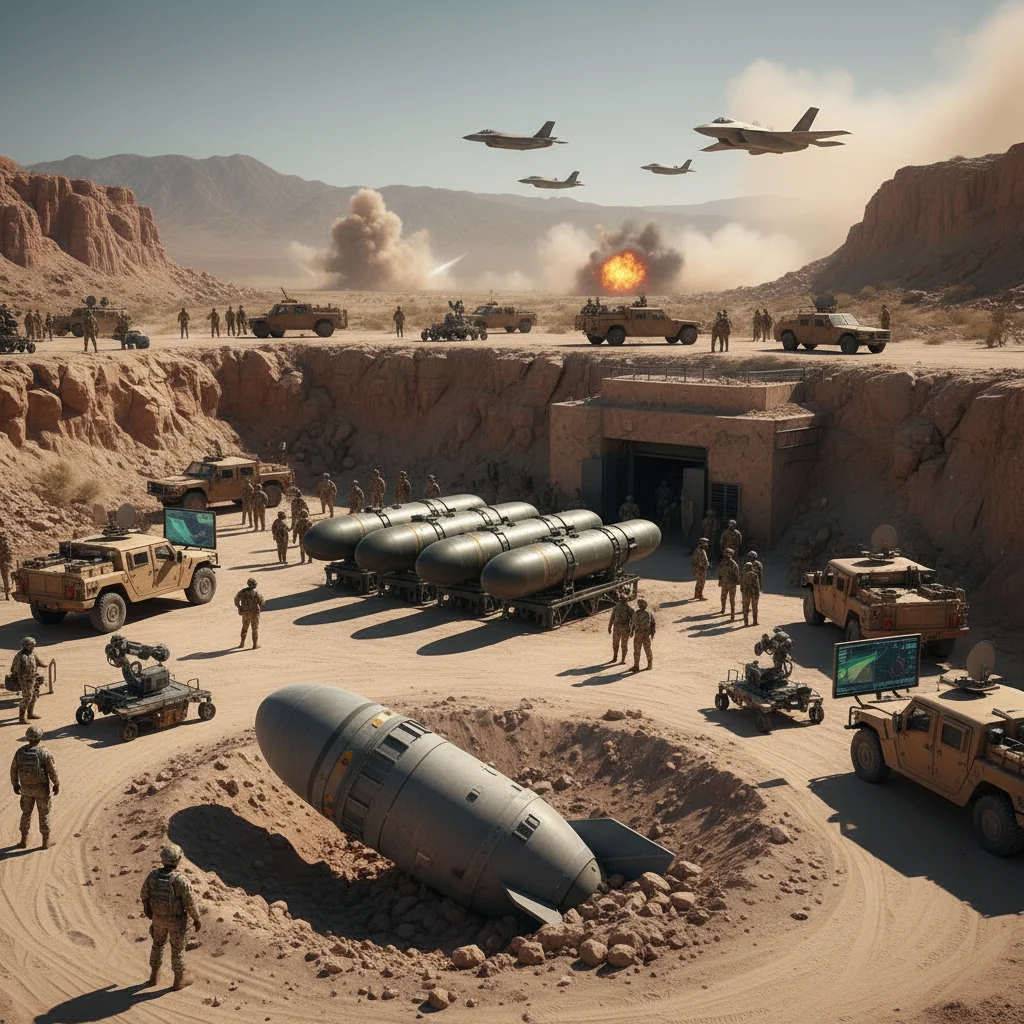
The Nevada desert shook with a force that felt like a minor earthquake. In the spring of 2026, the U.S. military ran some of its most intensive heavy-payload drills in a decade. The star attractions? Two very different giants of the conventional arsenal. On one side stood the GBU-43/B Massive Ordnance Air Blast, famously known as the “Mother of All Bombs” (MOAB). On the other were the latest deep-burrowing bunker busters, including the upgraded GBU-57 Massive Ordnance Penetrator (MOP).
These exercises weren’t just for show. As global tensions rise, defense planners are looking closely at how to crack heavily fortified targets. The drills highlighted a critical tactical question: when you need to destroy an underground fortress, do you flatten the mountain from above, or drill straight to its heart?
The Blast King: Understanding the GBU-43 MOAB
The MOAB is a legend of modern warfare, but it is often misunderstood. Weighing in at 21,600 pounds, it is the largest satellite-guided conventional weapon in the U.S. inventory. Yet, despite its terrifying size, the MOAB is surprisingly delicate in its delivery. It cannot be dropped from a traditional bomber. Instead, it rides on a cradle inside an MC-130 Combat Talon cargo plane, pulled out of the rear ramp by a drogue parachute before its grid fins guide it to the target.
But here is the catch. The MOAB does not actually penetrate the ground. It is designed to explode about six feet above the surface. The goal is sheer blast overpressure. By detonating in the air, the weapon spreads its shockwave horizontally across a massive area.
“It wipes out soft targets, clears minefields, and collapses shallow, unreinforced tunnel networks through raw atmospheric pressure,” says retired Air Force Colonel Marcus Vance, an analyst observing the drills. “But if you put a concrete slab over that tunnel, or bury it fifty feet under solid granite, the MOAB is basically just putting on a spectacular fireworks show.”
During the 2026 drills, crews simulated a strike on an open-air military encampment nestled in a valley. The mock blast cleared an area nearly a mile wide, demonstrating that for surface-level devastation, the MOAB remains unmatched.
The Earth Drills: Cracking Hardened Targets
For the deeply buried targets—the kind found in places like Iran, North Korea, or underground command posts in Eastern Europe—the military relies on a completely different class of weapon. This is the realm of the bunker buster.
The benchmark for this capability is the GBU-57 Massive Ordnance Penetrator (MOP). At 30,000 pounds, it is even heavier than the MOAB. But unlike its wide-girthed cousin, the MOP is built like a massive, hardened steel dart. It is dropped from extreme altitudes by stealth bombers, such as the B-2 Spirit or the newly deployed B-21 Raider.
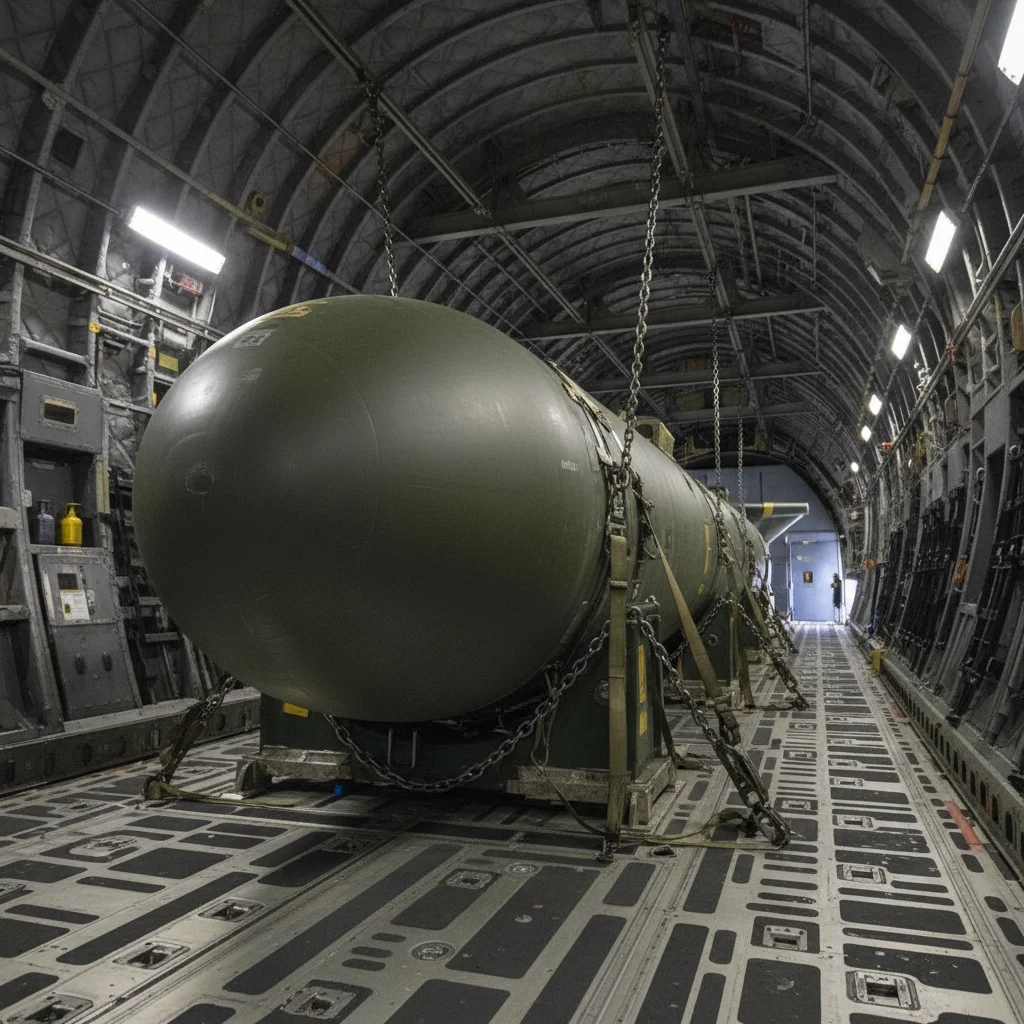
As it falls, gravity turns the MOP into a kinetic spear. It doesn’t explode on impact. Instead, its reinforced nose cone punches through up to 200 feet of earth or 60 feet of reinforced concrete before a delayed fuse detonates the warhead deep inside the bunker.
The 2026 exercises tested these penetrators against simulated underground command centers built deep into Nevada’s mesa formations. Sensors placed inside the mock bunkers recorded devastating internal pressure spikes and structural collapses that would have instantly neutralized any command staff inside.
A Tale of Two Deliveries
One of the biggest takeaways from the recent joint drills was the logistical reality of deploying these weapons. The MOAB requires absolute air supremacy. A slow, lumbering cargo plane like the C-130 cannot survive in contested airspace. If a conflict involves advanced air defense networks, the MOAB has to stay in its hangar.
Bunker busters, however, are designed for the stealth era. Because they can be carried inside the internal bays of stealth bombers, they can be deployed deep behind enemy lines during the opening hours of a conflict.
“The delivery system dictates the strategy,” Vance notes. “You use the MOP to knock out the enemy’s brains—their underground command centers—while they still have active air defenses. You bring in the MOAB later, once you control the skies and need to clear out surface positions or shallow trench networks.”
The Hybrid Tactic of the Future
Perhaps the most intriguing part of the 2026 drills was a simulated “one-two punch” tactic. Analysts watched as military planners tested a coordinated strike using both weapon types on a single, heavily defended valley complex.
In this scenario, a stealth-delivered bunker buster was dropped first to destroy a deeply buried power plant feeding an air-defense grid. Once the defenses were down, a cargo plane dropped a MOAB to sweep the surrounding valley, clearing out surface troops, light vehicles, and shallow bunkers in a single blow.
This hybrid approach shows that these giant weapons are not rivals. Instead, they are complementary tools in a very heavy toolbox. One shatters the roof, while the other sweeps the floor.
