
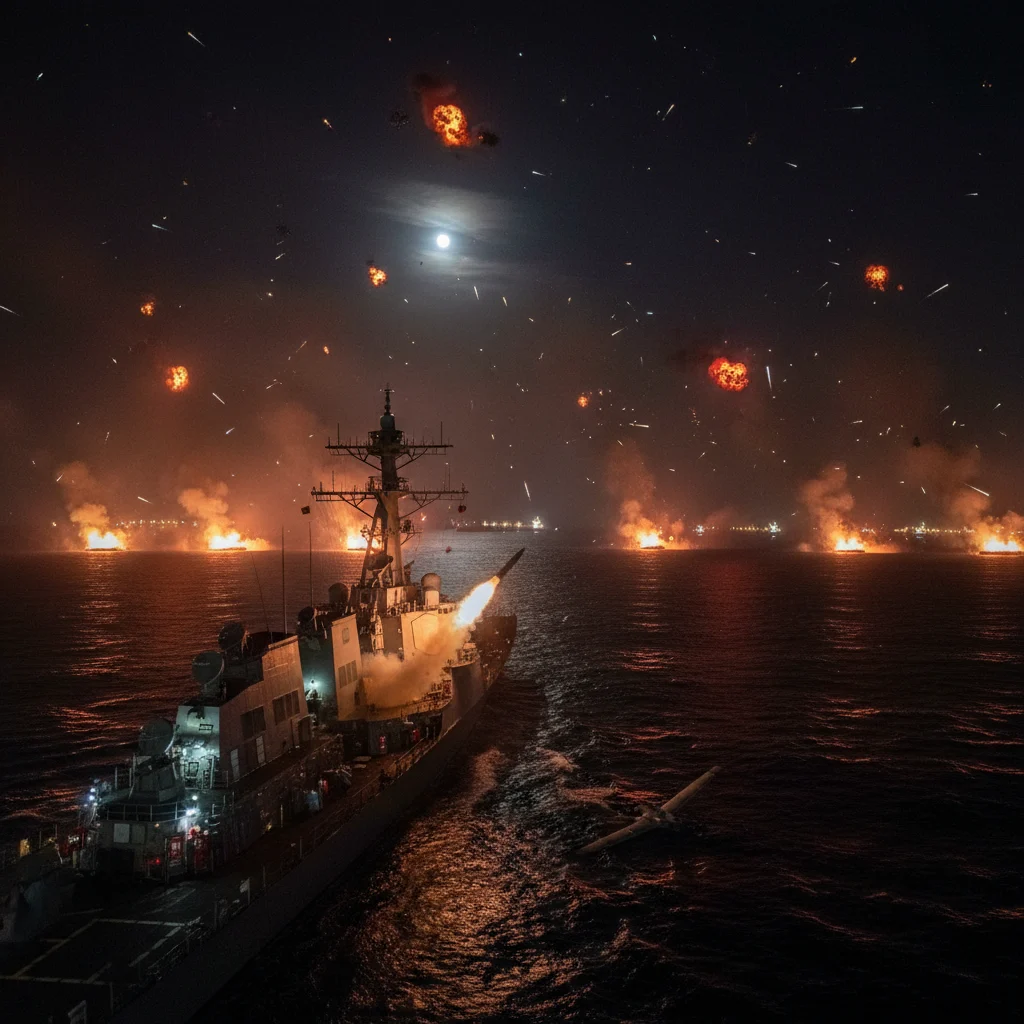
A Intense Night Over the Bab al-Mandab
The southern Red Sea became a high-stakes combat zone on Tuesday evening. In what defense officials are calling one of the largest coordinated attacks to date, Yemen-based Houthi rebels launched a swarm of one-way attack drones and missiles directly into international shipping lanes. For hours, naval crews monitored tracking screens, preparing to defend both military assets and vulnerable commercial vessels navigating the vital maritime corridor.
Thank you for reading this post, don't forget to subscribe!According to U.S. Central Command, the assault began around 9:15 p.m. local time. The offensive originated from Houthi-controlled territory in western Yemen. It targeted the busy lanes where dozens of merchant ships transit daily. The response from allied naval forces was swift and overwhelming. Warships and fighter jets scrambled to intercept the incoming threats, turning the night sky into a theater of anti-aircraft fire and missile interceptions.
The Coalition Response in the Air and Sea
A combined force of American and British assets met the incoming wave. The Pentagon confirmed that a multi-layered defense grid successfully neutralized the threat. Three U.S. Navy guided-missile destroyers—the USS Laboon, the USS Gravely, and the USS Mason—spearheaded the defensive effort. They were joined by HMS Diamond, a Type 45 destroyer from the British Royal Navy, and F/A-18 Super Hornet fighter jets launched from the aircraft carrier USS Dwight D. Eisenhower.
The engagement lasted for several hours as the coalition forces systematically tracked and destroyed the incoming threats. Military analysts noted that the coordinated defense showcase highlighted the capability of the joint task force, though the high-tempo engagement raised questions about the long-term sustainability of using expensive interceptor missiles against low-cost attack drones.
Breaking Down the Incoming Arsenal
The scale of the attack caught the attention of maritime security experts. Military sources detailed the sheer volume of weaponry launched by the rebel group during the operation:
- Eighteen one-way attack aerial vehicles (UAVs) designed to detonate on impact.
- Two land-attack anti-ship cruise missiles.
- One anti-ship ballistic missile aimed at the flow of commercial traffic.
None of the weapons reached their targets. Naval officials reported zero injuries and no damage to any civilian or military vessels in the area. It was a clean sweep for the defensive coalition, but the sheer volume of fire signaled a significant escalation in the ongoing regional tension.
The Staggering Costs of Maritime Defense
While the shootdown was a tactical success, it highlights a growing economic asymmetry. The Houthi rebels rely heavily on cheap, Iranian-designed technology. A typical one-way attack drone can cost as little as $10,000 to manufacture. In contrast, the surface-to-air missiles fired by U.S. and allied destroyers, such as the Standard Missile-2 (SM-2), carry a price tag of over $2 million per shot.
This cost disparity is a key element of the Houthi strategy. By forcing Western navies to deplete their stockpiles of sophisticated interceptors, the rebels hope to create long-term logistical and financial strain. Military planners are actively exploring alternative defense measures, including electronic warfare jamming and rapid-fire gun systems, to counter future waves more cost-effectively.
Why the Red Sea Matters to Global Trade
The Bab al-Mandab Strait is a narrow gateway connecting the Red Sea to the Gulf of Aden. It serves as a critical choke point for global commerce. Approximately 12 percent of all global trade passes through this corridor, including vast amounts of oil, liquefied natural gas, and consumer goods destined for Europe and North America. The alternative route is long and costly.
Because of the persistent threat, major global shipping companies have made difficult decisions. Industry giants like Maersk, MSC, and Hapag-Lloyd have suspended transits through the Suez Canal, opting instead to route their vessels around the Cape of Good Hope at the southern tip of Africa. This detour adds roughly 10 to 14 days to a typical journey from Asia to Northern Europe.
The extra distance translates directly into higher costs for consumers. Shipping lines must burn hundreds of thousands of dollars in additional fuel for every detour. Insurance premiums for vessels choosing to brave the Red Sea have also skyrocketed, forcing many smaller operators out of the region entirely. Supply chain analysts warn that prolonged disruptions could spark a new wave of global inflation as shipping rates double or triple.
The Geopolitical Chessboard
The Houthi movement, which controls large swaths of Yemen including the capital Sanaa, has stated that its actions are a direct response to the ongoing conflict in Gaza. The group claims it is targeting vessels with links to Israel or those heading toward Israeli ports. However, international maritime agencies dispute this claim, pointing out that many of the targeted ships have had no connection to Israel whatsoever.
Western intelligence agencies point to Tehran as the primary enabler of these strikes. While Iran denies direct involvement, Western officials maintain that the Islamic Republic provides the Houthis with critical intelligence, radar targeting data, and the advanced weaponry used in the attacks. This proxy dynamic complicates diplomatic efforts to defuse the crisis, as pressure on the Houthis directly does little to stop the supply of incoming weapons.
The Limits of Operation Prosperity Guardian
In response to the growing threat, the United States launched Operation Prosperity Guardian in December. The multinational coalition aimed to provide a reassuring naval presence in the Red Sea and restore confidence among commercial shipping firms. However, the coalition has faced challenges since its inception.
Several European allies have shown reluctance to place their warships under direct U.S. command, preferring to operate independently or under European Union frameworks. The latest massive drone attack suggests that the mere presence of Western warships has not deterred the Houthis, leaving defense officials to debate whether more active measures—such as striking launch sites inside Yemen—will be necessary to stop the attacks at the source.
What Lies Ahead for Regional Security
The successful interception of Tuesday’s drone swarm prevented a immediate tragedy, but it did little to resolve the underlying security crisis. The shipping industry remains on high alert. Many captains refuse to enter the Red Sea without armed security teams on board, and even then, the threat of ballistic missiles keeps crew members on edge.
The Pentagon faces a difficult choice. Continuing a purely defensive posture risks exhausting valuable naval munitions and wear-and-tear on crews deployed far from home. On the other hand, launching direct military strikes against Houthi military infrastructure inside Yemen could escalate the situation into a broader regional war, drawing in other regional actors and further destabilizing the Middle East.
For now, the destroyers of the coalition fleet remain on patrol, scanning the skies off the coast of Yemen. The commercial vessels that continue to run the gauntlet do so under the watchful eyes of naval radar, knowing that the peace of the Red Sea is currently maintained only by the rapid response of high-tech defense systems.
