
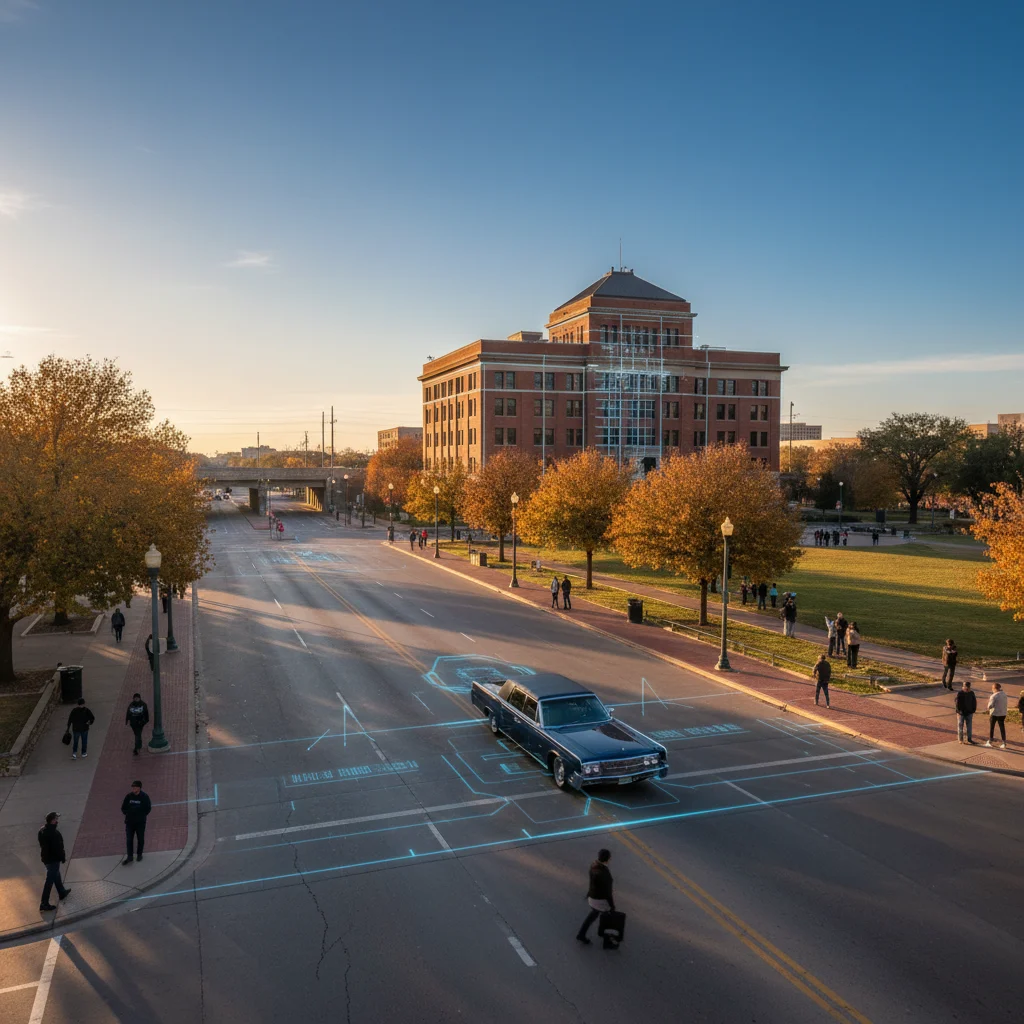
The autumn air in Dallas was crisp this week, much like it was sixty-three years ago. On November 22, 1963, three shots rang out across Dealey Plaza, changing American history forever. More than six decades later, the plaza looks peaceful. Tourists still gather on the grassy knoll, pointing up at the corner window of what was once the Texas School Book Depository. They argue about angles, echoes, and conspiracies.
Thank you for reading this post, don't forget to subscribe!But this year, the debate has moved from the pavement into the digital realm. A team of Texas-based spatial historians, forensic scientists, and acoustic engineers has spent the last year rebuilding Dealey Plaza. They did not use bricks or mortar. Instead, they used billions of laser beams and artificial intelligence to create the most accurate digital twin of the assassination site ever made.
The goal is simple: to use modern technology to test the physical limits of what was possible on that fateful Friday. By stripping away decades of environmental changes, researchers are re-evaluating the ballistics, the lines of sight, and the controversial acoustic evidence that has fueled skepticism for generations.
Recreating the Plaza of 1963
To understand what happened in 1963, you first have to erase the present. That is harder than it sounds. Over the last sixty-three years, Dealey Plaza has changed. Trees have grown, their thick branches now blocking views that were once wide open. Streetlights have been moved. Roadways have been repaved, slightly altering the slope of Elm Street. Signs have been replaced.
Dr. Charles Hughes, a spatial historian leading the digital restoration project, explained the challenge. “You cannot just walk into Dealey Plaza today with a scanner and expect to see what Lee Harvey Oswald saw,” Hughes said. “The oak trees on the grassy knoll and in front of the depository are massive now. In 1963, they were young, sparse, and newly planted. They did not block the view of the presidential limousine.”
To fix this, the team used terrestrial LiDAR, which stands for Light Detection and Ranging. They placed high-end scanners at dozens of points throughout the plaza. These devices fire millions of laser pulses per second, measuring the time it takes for the light to bounce back. The result is a highly detailed “point cloud”—a three-dimensional map accurate down to the millimeter.
Once they had the modern map, the team went to work on the historical editing. Using archival photos, surveyor blueprints from 1963, and FBI film footage, they digitally removed the mature trees. They replaced them with virtual models of the smaller 1963 foliage. They adjusted the road heights and restored historical traffic signs. For the first time, researchers have a perfectly accurate, three-dimensional time capsule of Dealey Plaza as it existed at precisely 12:30 p.m. on November 22, 1963.
Testing the Line of Sight
With the digital twin complete, the team turned their attention to the sixth-floor window of the depository. The Warren Commission concluded that Oswald fired three shots from this window using a bolt-action Mannlicher-Carcano rifle. Critics have long argued that the window offered a highly difficult, if not impossible, angle, especially given the speed of the limousine and the foliage of the trees.
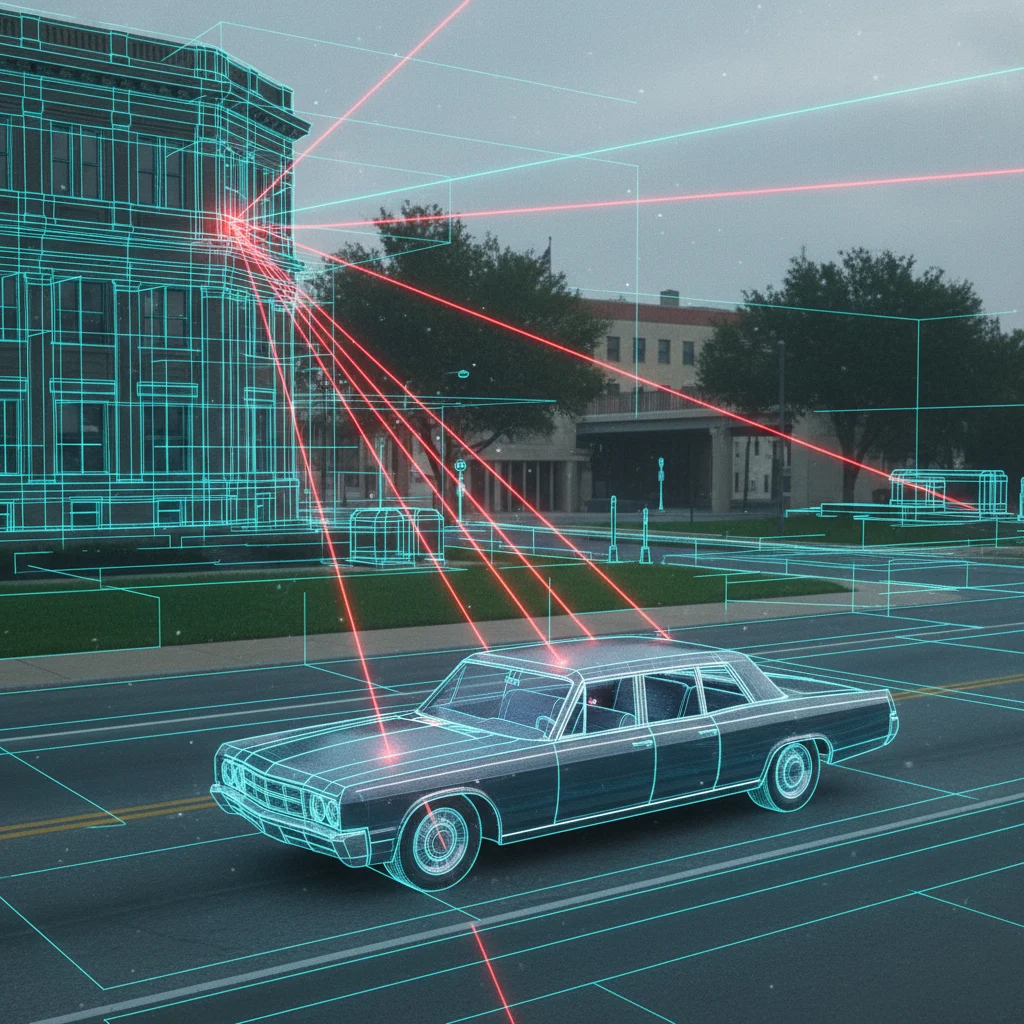
The new 3D model allowed researchers to place a virtual camera precisely where the rifle barrel would have rested. By simulating the movement of the open-top Lincoln Continental carrying President John F. Kennedy, the software calculated the exact percentage of the target visible at every fraction of a second along Elm Street.
“The data shows that the first shot, which many believe missed, was actually the most obstructed by a live oak tree, even in its smaller 1963 state,” Hughes noted. “But the second shot, which struck the President in the upper back, and the third shot, which was fatal, had clear, unobstructed paths. The physical geometry of the site absolutely supports the line of sight from that window. It does not prove Oswald was the only shooter, but it proves the shots from that location were physically viable.”
The team also analyzed the famous “Single Bullet Theory.” This theory suggests that a single round passed through Kennedy’s neck and went on to cause multiple wounds to Texas Governor John Connally, who was sitting in a jump seat in front of the President. Critics dubbed this the “magic bullet” theory, arguing the trajectory required the bullet to make impossible turns in mid-air.
GET FREE $1000 AMAZON GIFT CARD
By placing highly accurate 3D skeletal models of both men inside the virtual limousine, based on their exact heights and seating positions, the researchers ran ballistics simulations. The results were striking. When the limousine is mapped in true 3D space, rather than the flat 2D diagrams often used in conspiracy books, the trajectory is straight. Because Connally was seated slightly lower and to the left of Kennedy, a straight line drawn from the depository window passes directly through both men’s wounds without any need for the bullet to curve.
The Sound of a Gunshot
While the line-of-sight analysis supports the official narrative, the acoustic research presents a much more complex puzzle. For decades, the most controversial piece of evidence in the assassination has been a Dictabelt recording from a Dallas police motorcycle. In 1978, the House Select Committee on Assassinations analyzed this recording and concluded there was a 95 percent probability of a fourth shot fired from behind the wooden fence on the grassy knoll.
To test this, the research team partnered with Elena Vance, an acoustic forensic scientist. Vance used artificial intelligence and sound propagation software to recreate the acoustic environment of Dealey Plaza.
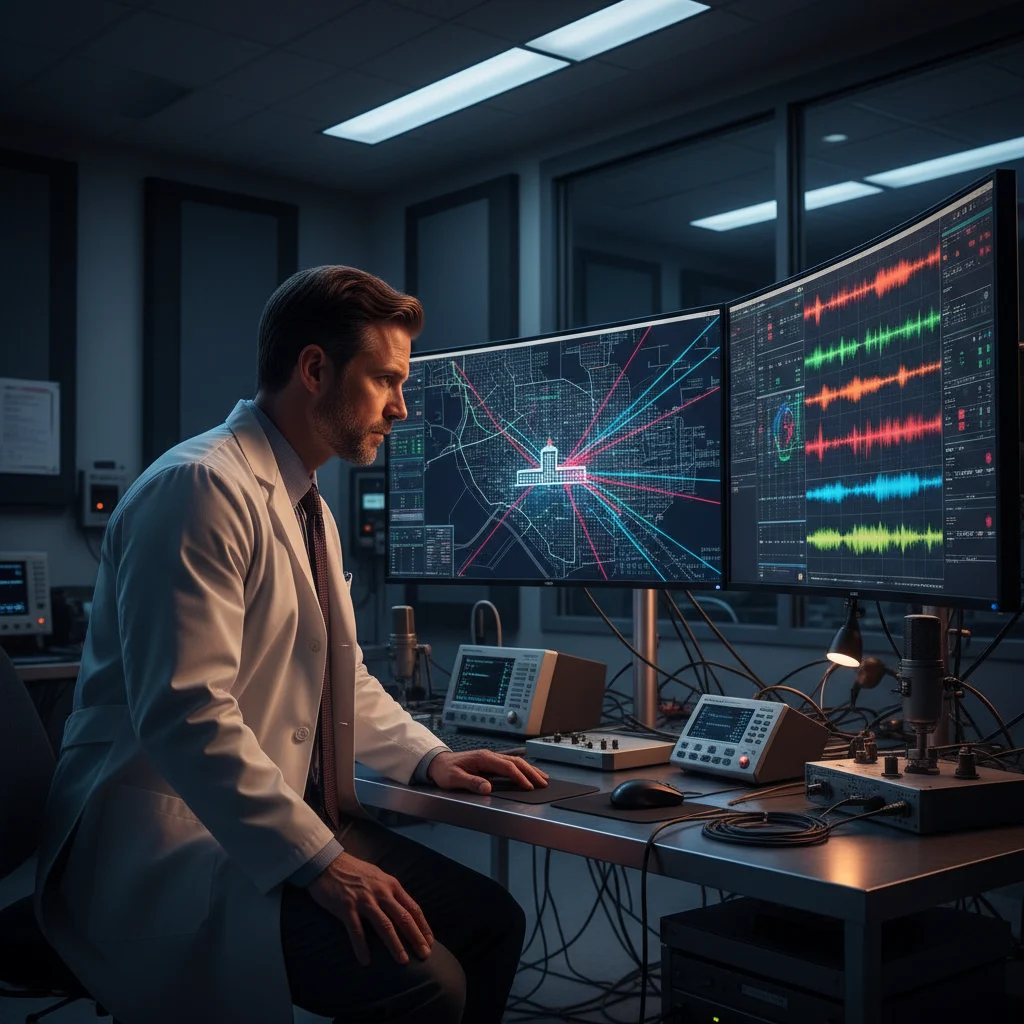
“Sound behaves like water,” Vance explained. “It flows, it bounces, it gets absorbed. When a rifle fires in Dealey Plaza, the sound waves hit the concrete underpass, the brick facade of the depository, the concrete pergolas, and the grass. It creates a unique acoustic fingerprint.”
Vance’s team trained an AI model on the acoustic properties of a 6.5mm Carcano rifle and other historical firearms. The AI simulated the sound of shots fired from both the sixth-floor window and the grassy knoll. It calculated how those sound waves would have traveled and echoed through the plaza, and how they would have been picked up by a moving motorcycle microphone.
The findings revealed a massive problem with the original 1978 acoustic analysis. The concrete triple underpass at the end of Elm Street acted like a giant acoustic mirror. A shot fired from the depository window would bounce off the underpass, creating an echo that, to a listener or a microphone on the street, could easily sound like a second shot coming from the grassy knoll.
“The AI was able to separate the primary muzzle blasts from the reflections,” Vance said. “What we found is that many of the audio spikes previously identified as shots from the grassy knoll are, in fact, delayed reflections of the shots fired from the depository. The acoustic space in Dealey Plaza is incredibly deceptive. It tricks the human ear, and it tricked early audio analysis equipment.”
A Cold Case in a Virtual World
This new research does not settle every debate. It was not designed to. In a case as deeply rooted in American mythology as the JFK assassination, no amount of data will ever satisfy everyone. There will always be questions about motives, missing files, and mysterious figures.
What this technology does, however, is ground the debate in cold, hard physics. It removes the guesswork from the physical space. By bringing Dealey Plaza into a virtual laboratory, historians and scientists can test theories that were previously untestable without blocking traffic on Elm Street or firing live rounds in a public park.
As the sun set over Dallas on the anniversary of that dark afternoon, the real Dealey Plaza went quiet. But in the servers of the researchers, the digital limousine continues its slow drive down Elm Street, replay after replay, as science tries to untangle the seconds that changed the world.
